· Edition #2

The Busbar

Battle Born publishes a technical note arguing its melting positive terminal is a deliberate thermal fuse; Will Prowse and Mike Sokol set up independent verification. Multi RS firmware v1.29 adds Denmark grid code; Bluetti's FridgePower hits Kickstarter; China's PV export VAT rebate ends 1 April.

Battle Born says the melting positive terminal is by design — independent investigators move to verify

Battle Born published a technical note on 31 March arguing that the failures documented across forums, autopsies, and Will Prowse's bench are an intentional 'passive thermal fuse' that triggers around 85 °C. Will Prowse and RV-electricity's Mike Sokol have both responded — Prowse with a video disputing the framing, Sokol with a controlled load-bank test now under way.

The Battle Born 100Ah safety story moved into a new phase on 31 March, when Battle Born Batteries published a "Technical Note on the Safety and Design of the Battle Born 100Ah Positive Terminal." The note reframes the discoloured, melted positive terminals documented across the Airstream, iRV2, Escape Trailer and Jayco owner forums — and dissected on Hackaday and Will Prowse's bench through Q1 — as a deliberate "passive, irreversible shutdown mechanism."

Battle Born's argument: the model BB10012 terminal stack uses a PA-765 polymer layer that softens at 85 °C. Under sustained thermal fault, the polymer loses elasticity, contact pressure drops to near zero, and an aluminium-oxide film (Al₂O₃) forms on the aluminium connecting bolt. That oxide is electrically insulating and interrupts current flow. The note quotes a normal-operation envelope of "less than 200 microohms" terminal resistance, "under two watts" of heat dissipation at 100 A continuous, and a 20 mV voltage drop. Battle Born says the mechanism has triggered roughly 700 times in the field since early 2022, "always as designed and without a single instance of fire or cell damage" — a rate the company puts at about 0.4 % of 100 Ah batteries sold from May 2022 to December 2025.

Independent investigators are not yet convinced. Will Prowse posted a video response on 9 April ("Battleborn Batteries Responds: Our Batteries Work Great!") disputing Battle Born's framing — particularly the company's claim that autopsy work has prevented the oxide layer from "functioning" — and pointing to the field reports of loose bus-bar connections that occur well below any thermal-fault threshold. RV-electricity's Mike Sokol published his test bench on 8 April: a 2 kW inverter into an Avtron K490 load bank, planning runs at the manufacturer's rated 100 A continuous and stress runs with 40 A and 80 A chargers against the rated 50 A maximum. Hackaday covered the technical note on 10 April.

For owners, the live question is whether a triggered terminal in their pack represents the system working, or a connection-quality problem operating below the design envelope. The answer will depend on what Sokol, Prowse, and other testers find on instrumented benches in the next several weeks.

Multi RS firmware v1.29 adds Denmark grid code, fixes phase-rotation drops

Released 26 March, the update reduces 'multi phase issue' disconnects in three-phase systems, adds Denmark grid-code support, and forces RS chargers into safe mode if the VE.Bus BMS is removed mid-operation.

Victron released Multi RS firmware v1.29 on 26 March. The headline change is improved phase-rotation detection: three-phase RS systems were disconnecting under "Multi phase issue" alarms when phase mapping drifted at boot, and v1.29 reduces the rate at which that happens. The release also adds Denmark grid-code support to the Multi RS, fixes a communication bug with the VE.Bus BMS v2 and the new VE.Bus BMS NG that could leave a charger running unsafely after the BMS was unplugged, and prevents the inverter restarting when phase assignment changes in standalone mode. New warning #77 flags mixed synchronisation configurations, and partial sync of system configuration is now possible across units sharing phase-rotation settings. The update applies to the Multi RS and Inverter RS ranges and is available via VictronConnect, Victron Professional, or the VRM Portal.

VictronConnect v6.32 fixes stuck trends, VE.Bus update error 29, and Android Auto crashes

Released 31 March, v6.32 cleans up several regressions introduced in v6.30 — most notably the Trends view getting stuck on 'fetching' and a firmware-update path that produced error 29 on VE.Bus inverter/chargers.

Victron released VictronConnect v6.32 on 31 March, focused on cleaning up regressions introduced in v6.30. The Trends view, which on some installations was hanging in a permanent "fetching" state, now resolves properly. A more operationally serious fix addresses a path through the VE.Bus inverter/charger firmware updater that produced error 29 — the cause of intermittent failed updates on MultiPlus and Quattro hardware over the last several weeks. On Android, the products list inside Android Auto is more stable, and the "last contact" timestamp displayed by the home-screen widget is now accurate. VictronConnect updates roll out automatically on most platforms.

Bluetti FridgePower hits Kickstarter — 2 kWh LiFePO4 backup designed to live next to the fridge

Bluetti launched the FridgePower on Kickstarter on 16 April: a 2,016 Wh LiFePO4 unit rated 1,800 W continuous in a 75 mm-thick wall-mount or stack-on-fridge form factor, with 10 ms switchover and ~22 hours runtime on an 18–22 cu.ft. fridge. Backer price $759; retail $1,299.

Bluetti opened a Kickstarter for the FridgePower on 16 April. It is a 2,016 Wh LiFePO4 backup with a 1,800 W continuous AC inverter, two AC outlets, and an XT60 solar input that accepts 12–60 V at up to 20 A (1 kW max). The unit is 75 mm (2.95 in) thick and weighs ~19 kg (42 lb), intended to wall-mount alongside the fridge or stack on top of it; switchover during a grid loss is quoted at 10 ms. Cells are LFP rated to 4,000 cycles to 80 % capacity. Backer pricing starts at $759 (versus a $1,299 retail target), with FridgePower + BlueCell 200 expansion bundled at $1,398 — that combination extends fridge runtime to roughly 40 hours. The campaign runs through 31 May; deliveries are scheduled to begin early June. While framed as a residential backup, the form factor and 12–60 V solar input make this directly usable as a mobile or off-grid 2 kWh node.

Find on Amazon →

Off-Grid Garage flags JK Inverter-BMS firmware V19.31B — install only with care

Andy Schroeder's 11 April video calls out a special V19.31B build of the JK Inverter-BMS firmware that ships with the parallel-BMS feature unlocked. He recommends most users skip it: it has known compatibility quirks, and a flash failure can brick the BMS.

JK BMS V19.31B is a special build of the v19.x firmware tree that unlocks parallel operation of more than 16 BMS units — a configuration users have been requesting for over a year. In a 11 April video titled "Do not install this special JK Inverter-BMS Firmware V19.31B. Unless…" Off-Grid Garage's Andy Schroeder explains the trade-off: the firmware enables parallel-BMS but carries known issues affecting RS485 inverter communication on some inverters, including reports of charging halting when grid power is present. Schroeder's recommendation is to flash only with no load (or very light load) on the bank to reduce the chance of noise-induced flash corruption — flashing under load can brick the BMS. Builders not specifically planning to parallel beyond 16 BMS units should stay on the prior shipping firmware until JK consolidates the parallel-BMS work into a mainline release.

Casely Power Pods recall reannounced after a fatality — 429,000 power banks affected

CPSC reannounced the Casely Power Pods recall on 16 April after a 75-year-old New Jersey woman died from burns sustained when the unit ignited in her lap, and a separate February 2026 incident saw a 5,000 mAh Power Pod ignite on an aircraft. Different chemistry to ours — but the failure mode is the one to keep in mind.

The Consumer Product Safety Commission reannounced its recall of Casely's 5,000 mAh MagSafe Power Pods on 16 April. Roughly 429,000 units (model E33A, sold March 2022 through September 2024 between $30 and $70) are covered. CPSC reports a 75-year-old New Jersey woman died from burns sustained in August 2024 after the device ignited while charging her phone on her lap, plus 28 additional incidents including an in-flight ignition in February 2026. These are lithium-ion (not LiFePO4) consumer power banks, not the chemistry most readers run on a boat or in a van — but the takeaway translates: a small pouch cell in a sealed plastic shell, charged with a phone on a lap or sleeping bag, is a category of risk worth treating seriously. Owners can request a free replacement via Casely.

The Background · Market Analysis

China's PV export VAT rebate ends 1 April — what off-grid builders should expect on panels and cells

On 9 January 2026 China's Ministry of Finance announced that, effective 1 April 2026, the export VAT rebate would be eliminated for 249 product categories — including solar cells, modules, inverters, and several lithium battery components. For battery products specifically, the rebate moves from 9 % to 6 % between 1 April and 31 December 2026, then drops to zero on 1 January 2027. The change is now in effect, and the supply chain has been adjusting to it for weeks.

Why the rebate matters

Chinese manufacturers were previously eligible for VAT rebates on exported goods — 13 % through most of 2024, reduced to 9 % in December 2024. That rebate was a meaningful component of the price competitiveness of mainland-produced solar modules and battery products, and importers in the EU, Australia and (where tariffs allowed) the US benefited from it indirectly through lower CIF prices. Removing the rebate raises landed cost without changing factory cost.

What's already moved on panels

PV-Tech, ESS-News and the European installer market have all reported "panic buying" through February and March, with some module categories rising 20–30 % in spot pricing as Chinese manufacturers ran lines flat-out ahead of the deadline. Industry analysts are converging on a sustained module-price increase in the range of 10–14 % through 2026 — from approximately $0.086/W in late 2025 toward $0.098/W by Q4 2026 — once the panic-buying surge clears. A faction of forecasts goes higher, citing concurrent silver-price pressure (silver up >30 % in 2025) and EVA / aluminium / glass cost increases that were already moving before the rebate change. The 30–40 % surge numbers seen in recent press tend to reference combined effects rather than the rebate alone.

Effect on US-bound product

Most off-grid builders in the US are not buying mainland-Chinese silicon directly — Section 201 / 301 / AD/CVD duties have pushed roughly 80 % of US PV imports through Cambodia, Malaysia, Thailand and Vietnam since the early 2020s. Those Southeast Asia panels are not directly subject to the VAT rebate change, but the Chinese spot price is the floor that sets regional alternatives, and the cell supply behind many SEA-assembled modules is still mainland-Chinese. Expect a smaller pass-through to US retail prices than to European pricing — but not zero.

Effect on cells and packs

The cell side is moving more slowly. The headline 9 %→6 %→0 % schedule applies to LFP and NMC cell exports broadly, and the second-half 2026 cell pricing for prismatic 280 Ah and 314 Ah formats is the data point worth watching for raw-cell builders. The EVE MB31 and CATL formats covered in the previous edition were stable through April, with US retail four-pack pricing holding around $83–$85 per cell. The pricing impact, if it materialises in the cell market, is likely to land in late Q3 or Q4 2026 as inventory built up before 1 April clears, then again in Q1 2027 when the rebate goes to zero.

What to do about it

For a large planned purchase (a full panel string, a 16-cell raw-cell bank), the spread between buying now versus waiting six months is real but bounded — likely 5–12 % on panels and a smaller, later move on cells. For a builder who has already spec'd a system and has the cash to commit, buying through summer 2026 is probably the better choice. For builders with flexibility, the cell market in late 2026 is worth watching — particularly if pre-built pack pricing tracks the cell move, since rebate-free cell pricing could narrow or reverse the cost gap recently developing between raw-cell builds and pre-assembled budget packs.

Community Pulse

What the forums are talking about this week

The Battle Born safety thread is now spread across nearly every owner forum in the RV market. The most active in April are the Airstream Forums "12V 100Ah Battery Failures: Field Reports, Testing, and Alternatives" thread, the iRV2 "Battleborn Battery Safety Issue" thread, and the Escape Trailer Owners Community's two parallel threads. The content is roughly the same in each: photos of discoloured terminals, requests for warranty handling experiences, and increasingly substantive discussion of replacement options. Battle Born's 31 March technical note has surfaced in all four threads in the last week and is splitting the readership between "the design did its job" and "this happened on a brand-new pack at 30 A."

On DIYSolarForum, a thread asking what BMS is in the LG Chem ESS modules opened on 9 April and is generating the kind of careful, primary-source discussion the forum is at its best with — datasheet links, attempted CAN sniffing, and a couple of users who have actually opened up a module to look. It's a good reference for anyone considering a second-life ESS path.

On the Bench

YouTube picks: builds, teardowns, firmware walkthroughs, and reviews

SOC Accuracy Test Result: New Gobelpower BMS vs JK-BMS vs Victron Smart Shunt
Review
Off-Grid Garage · April 2026
Andy Schroeder runs a controlled SOC-accuracy comparison between the new Gobelpower P16S200A BMS, a JK Inverter-BMS, and a Victron SmartShunt across a discharge cycle. Concrete data on where each device drifts and how each handles full-charge calibration — relevant if you're spec'ing a BMS or wondering whether the SmartShunt is still worth its place in the system.
Battleborn Batteries Responds: Our Batteries Work Great! "Technical Note" Explained
Firmware Deep-dive
DIY Solar Power with Will Prowse · April 2026
Will Prowse's video response to Battle Born's 31 March technical note. He goes through the company's claims point by point, particularly the ABS-thermoplastic / aluminium-oxide thermal-fuse mechanism and Battle Born's argument that autopsy disassembly disturbs the oxide layer. Companion to this week's lead.

Product Radar

New and notable components announced or launched this week

Battery

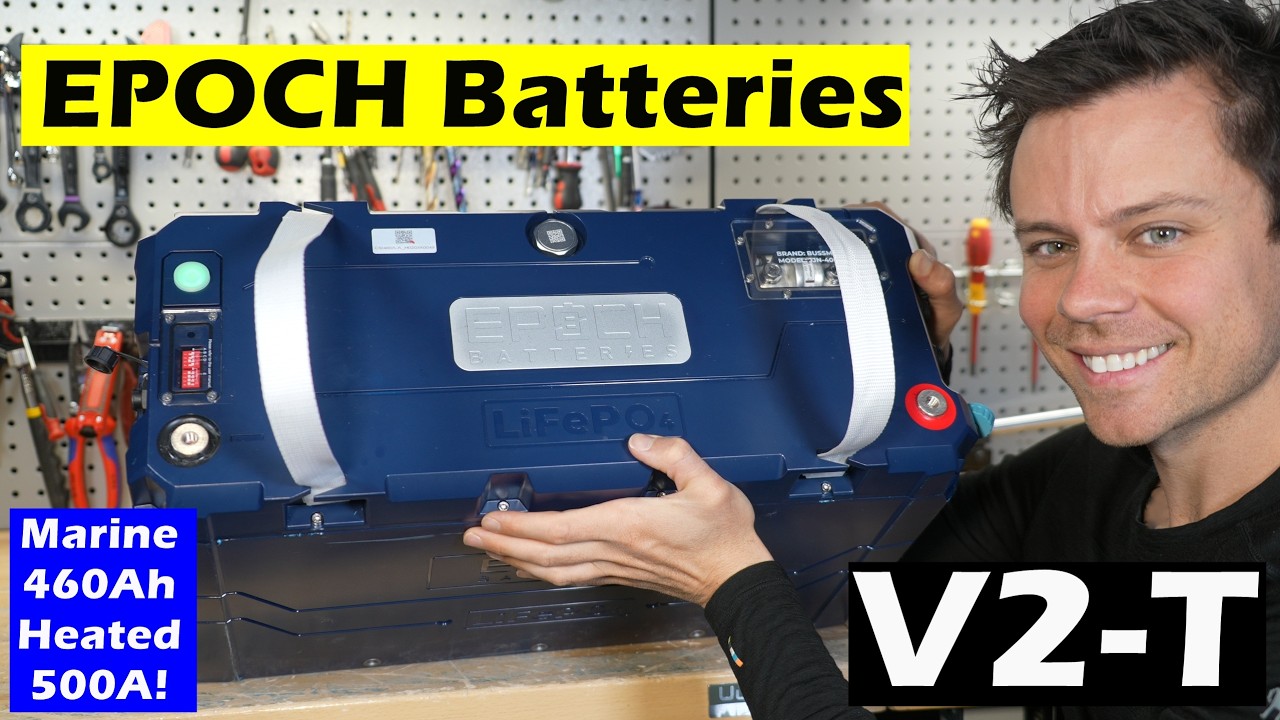
Group 8D 12.8V 460Ah / 5.89kWh marine-rated drop-in. IP67 housing, internal heater (auto-engages at ~5°C), factory-integrated 400A Eaton Class T fuse, Bluetooth and Victron CAN-bus comms. 230A continuous discharge.

$2,199 Shipping now via Epoch direct and authorised marine resellers Find on Amazon →
The factory-integrated Class T is the meaningful change versus the regular V2 — it removes a separate fuse and short cable from the install, which on a marine bank is real cost and real complexity savings.
Battery

2,016 Wh LiFePO4 (4,000-cycle cells), 1,800 W continuous AC, two AC outlets, 1 kW XT60 solar input (12–60 V). 75 mm slim chassis for wall-mount or fridge-stack install. 10 ms grid-loss switchover; ~22 hr runtime on an 18–22 cu.ft. fridge.

$759 backer / $1,299 retail target Kickstarter campaign through 31 May; deliveries from early June 2026 Find on Amazon →
Marketed as residential fridge backup, but the form factor and DC solar input are directly usable as a 2 kWh off-grid node for a van or cabin. Kickstarter risk applies.
EnergyPro 13K — Bluetti
Inverter

13.2 kW 120/240V hybrid inverter (EP13K) with the AT1 smart distribution panel and modular EnergyPack 500 batteries (4.8 kWh each). 22 kW max PV across 4 MPPTs. AC- or DC-coupled. EP13K is IP65/NEMA 4X, 48 kg.

From $7,919 Shipping in the US since 7 April 2026
Heavier than typical Busbar territory — primarily a residential / small-commercial ESS rather than a mobile rig — but the 22 kW DC solar input and modular battery side make this relevant for cabin and small-farm builds.