· Edition #15

The Busbar

Will Prowse puts three 300lb 48V batteries through a new 18kW cycler and finds a fuse hitting 220°F that trips the BMS before the cells even warm up; Panbo takes apart the word 'solid-state' in marine batteries; and Expion360 pushes UL 1973 lithium into two more Forest River motorhome brands.

Prowse cycles three 300lb 48V packs at 200A: the fuse fails long before the cells do

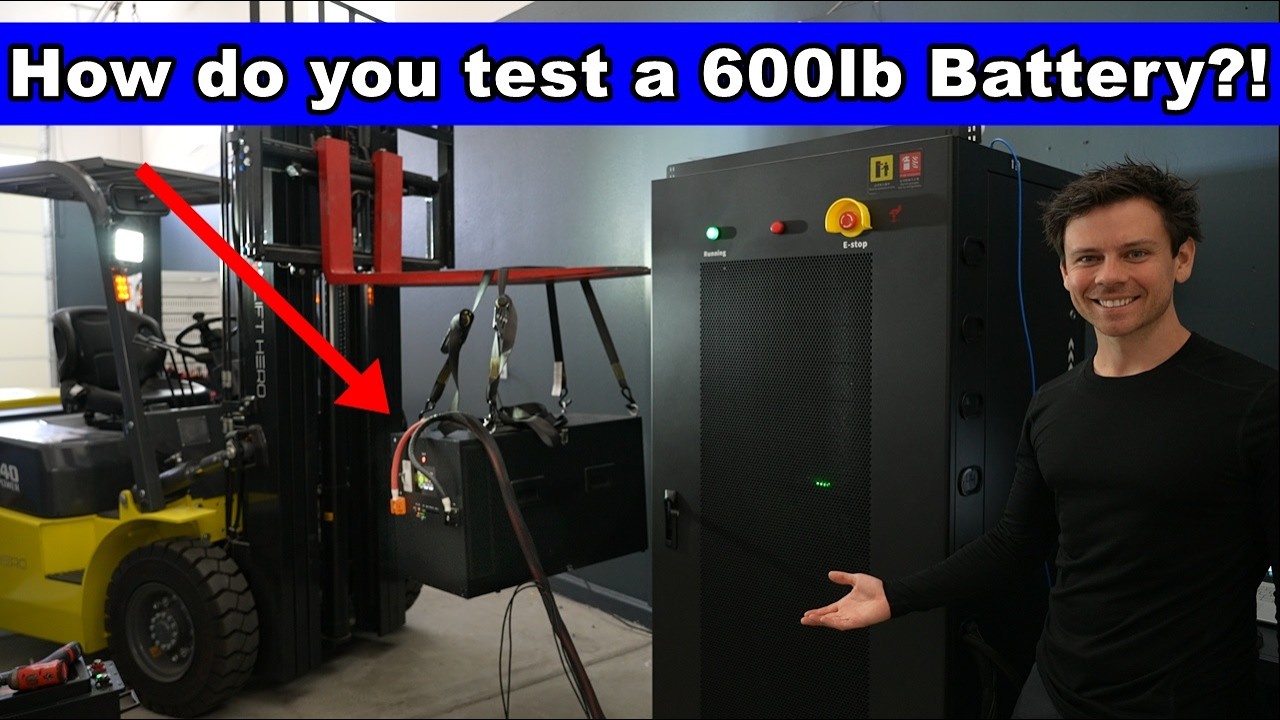
In an 8 August test, Will Prowse pushed EG4, Ruixu and Yixiang large-format 48V batteries to 200A continuous on a new 18kW cycler. The cells were never the limit — an internal fuse running at 220°F and an over-sensitive BMS threshold were.

Will Prowse published a three-way test on 8 August of large-format 48V batteries — EG4, Ruixu Lithi, and a Yixiang budget pack — each roughly 300lb and about the size of three server-rack batteries stacked. The interesting result isn't which one won. It's where the failures came from.

Capacity first. Two of the packs were three years old, and Prowse had treated them very differently: one took roughly 12MWh of forced charge/discharge cycling, the other was barely cycled at all. Both then sat uncharged in a metal building in Las Vegas through two summers. Measured capacity differed by 0.6%. That's an empirical data point for something we covered as theory in the 1 June background on calendar vs cycle aging: for LFP in normal solar service, the clock does more damage than the cycling.

Then the 200A continuous cycle test. The Yixiang pack failed early — but not because of its cells. Prowse pulled it apart, put a thermal camera on it, and found the internal fuse at 220°F, hot enough to raise the temperature of the adjacent cells and trip the BMS. Bypassing the fuse fixed it. A second, horizontal Yixiang unit had no fuse at all, showed uniform cell temperatures, and still tripped early — the BMS turned out to be sharply sensitive right around 200A. Dropped to 198A, it matched the Ruixu.

The EG4 held up best, and Prowse attributes that to layout rather than cells: its BMS sits in a larger compartment, further from both the cells and the breaker, so heat soak from the pack doesn't reach the electronics. Worth keeping in proportion — all three are rated 140A continuous, all three pass comfortably at that rate, and Prowse notes the MOSFETs stay below 40°C through back-to-back cycling. In none of the tests did the cells themselves get hot. The 200A run is a test of everything around the cells, and that's exactly where these packs differ.
Expion360 adds Georgetown and Dynamax Grand Sport to its Forest River OEM lithium programs

In its 7 August Q2 results, Expion360 said Forest River has selected its UL 1973-certified lithium systems for two more motorized RV brands. Sales fell 32% year over year; gross margin rose 11.6 points.

Expion360 reported Q2 2026 net sales of $2.0 million, down 32% year over year but up 30% on Q1, with gross margin expanding from 20.8% to 32.4% — which CEO Joseph Hammer attributed to dropping resale of low-margin accessories rather than to any pricing move. Net loss was $1.3 million; cash stood at $1.5 million at 30 June. The company completed a 1-for-12 reverse split on 21 July and regained Nasdaq bid-price compliance on 4 August.

The part that matters outside the ticker: Forest River — a Berkshire Hathaway subsidiary and one of North America's largest RV builders — extended its use of Expion360's UL 1973-certified lithium systems to the Georgetown and Dynamax Grand Sport motorized brands, on top of existing Dynamax and East to West programs. Factory-fit certified lithium in motorhomes is still the exception rather than the rule; each OEM win moves it closer to default. Expion360 also said it remains on track to launch the first of its next-generation batteries in the second half of 2026, with VHC internal heating, SmartTalk Bluetooth and CAN bus — though the August release did not restate the model-by-model capacities given in February's announcement.

JK Inverter-BMS V19.34 adds manual SoC, SoH and cycle calibration — and Off-Grid Garage finds the cycle counter measures half a cycle

Jikong's V19.34 firmware lets you override state of charge, state of health and cycle count by hand. Testing it on 29 July, Andy at Off-Grid Garage found the 'cycle capacity' field counts only discharged Ah — so a full cycle reads as two.

The firmware itself shipped on 30 May; what's new is that the settings are reachable, via JK BMS Android app v6.0.10, and that someone has now tested them. Off-Grid Garage walked through all three on 29 July. Manual SoC override matters when a bank sits through a winter without a full charge and the BMS estimate drifts; manual SoH (floor: 50%) matters when you swap in a replacement BMS, which otherwise assumes the pack it has just met is brand new.

The third one has a catch. Andy found that JK's cycle capacity figure counts only amp-hours discharged — charge current is never added. On a 314Ah pack, entering 314Ah registers one cycle, and 628Ah registers two, when 628Ah discharged-plus-charged is physically one full cycle. He confirmed the same behaviour on B-series and PB-series units, so it isn't specific to V19. The arithmetic still works if you divide cycle capacity by pack capacity — you just have to know the label means discharge capacity, not cycles.

Gobel Power ships the Thor 5000: 5.1kWh in a 135mm-deep case, designed in Germany, built in Shenzhen

A 51.2V 100Ah rack battery on REPT cells with a JK Inverter-BMS, notable mainly for packaging — 135mm deep against roughly 180mm for comparable units, and light enough to carry without a trolley.

Off-Grid Garage unboxed the Thor 5000 on 7 August: 5.1kWh, 51.2V, 100Ah, REPT cells, a JK Inverter-BMS (JK_PB1A16S10P V19) with 1A active balancing, and an integrated 100A DC breaker rated to 250V DC. Gobel quotes 6,000 cycles to 80% SoH at 80% DoD, 3,000 at 100% DoD, and a 10-year warranty; list price is $1,382, with stock in both China and Germany warehouses.

The story is the enclosure. At 135mm deep it undercuts comparable 100Ah rack batteries at around 180mm, and at roughly 41–44kg it's a one-person carry — Andy notes he carried it from his front gate to the garage, which is not the usual experience with a 5kWh pack. Steel case as standard, 201 stainless optional. On the "German designed" billing: the design work is credited to Autong in Germany, but Gobel Power is a Shenzhen manufacturer founded in 2012, and the cells are REPT. Designed there, built here — worth reading the phrase precisely.

$699 for 5kWh on Amazon: the Paoweric pack is rated 200A behind a 100A breaker

Prowse tested and tore down the cheapest server-rack battery he could find on Amazon. Capacity measured mid-pack and respectable; the 200A rating did not survive 54 seconds.

The Paoweric 5kWh unit costs $699 and is nominally rated 200A. Prowse ran it at 200A on the cycler and it lasted 54 seconds — the integrated DC breaker is marked 100A. At 100A it delivered a measured 104.8Ah on discharge, which he called mid-pack and better than he expected for the money. It's also only 13in wide against the 17.5in standard, so it will not fit most server racks.

The teardown is where it turns. No inductor on the BMS, so no current throttling; solder blobbed onto a nickel sheet welded to an aluminium busbar; six wires landed on a single busbar; both temperature sensors attached with tape; fibreboard at the ends of the cell stack but nothing between cells. Prowse's summary was blunt — not a good battery — and his framing is the useful bit: for about $150 more you can buy a pack listed to UL 1973 and UL 9540, which is what permitting and insurance actually turn on. The gap between certified and uncertified used to be wide enough to explain itself. It's narrowing.

The Background · Trend Piece

"Solid-state" is doing a lot of work in marine battery marketing

Panbo's Ben Stein published a piece on 7 August that does something the DC world needs more of: it takes a term that has started appearing on product pages and asks what it actually denotes. The answer, for every solid-state battery you can currently buy for a boat, is semi-solid — a cell that still contains somewhere between 5% and 20% liquid electrolyte.

The case for going solid is real. Replacing the graphite anode with lithium metal is worth up to 60% more energy per unit weight. Removing the flammable organic solvent removes the thing that burns in a thermal runaway. In the lab, all-solid cells have reached 80% charge in fifteen minutes, and cutting the parasitic side reactions that consume electrolyte should extend cycle life. Those are four genuinely large improvements and they are why every major cell manufacturer is spending on it.

None of them arrive in proportion when the cell is still 10% liquid. A semi-solid cell keeps some of the safety benefit — less solvent means less fuel — but it is not the non-flammable pack the name implies, and the energy-density jump depends on the lithium-metal anode, not on the electrolyte being stiff.

Who is selling what

Stein names three. Renogy is explicit that its cells contain about 10% liquid electrolyte, which is the honest end of the range. Safiery, the Australian caravan and marine outfit, sells a semi-solid pack built on lithium iron phosphate. Solid State Marine has not confirmed its chemistry, and Stein is openly sceptical of the claims being made — his reading is that it is nickel manganese cobalt.

That last distinction matters more than the solid/semi-solid one. NMC carries more energy per kilogram, which is why it dominates in EVs. It is also less thermally tolerant than LFP and has a shorter cycle life, and in a 12V house bank — where the pack sits at high state of charge for weeks, gets charged by an alternator whose regulation you may not fully control, and lives in a hot locker — those are the wrong trade-offs. A boat is not a car. Buying an NMC pack because the label said "solid-state" would be buying the marketing and inheriting the chemistry.

The timeline

Cell makers are broadly targeting the back half of this decade for commercially viable all-solid-state, and it will show up in electric vehicles first. Marine and mobile are downstream of automotive volume on every battery technology, and manufacturing immaturity is what keeps the cost high. Nothing about that says semi-solid packs are bad products — Safiery's LFP-based pack is a reasonable thing to buy on its own merits. It says the word on the box is ahead of the technology in the box.

Stein draws the parallel to "drop-in", a term that spent several years implying that a LiFePO4 pack could replace lead-acid with no other changes, and which quietly cost people alternators, charge controllers and warranty claims. The pattern is the same: a phrase that is technically defensible in a narrow sense, doing broad work in a buyer's head. The defence is the same too — ask what chemistry, ask what percentage of the electrolyte is liquid, and treat the category name as marketing until someone shows you a datasheet.

Community Pulse

What the forums are talking about this week

A quiet week on the forums for electrical content, but two r/vandwellers threads are worth a look. One is a maker release: a builder published RoofFlangeForge, a browser tool that takes your roof measurements and generates an STL for a printable roof flange or adapter — written because they needed one for their own van and decided to solve it parametrically rather than once. Roof penetrations are where cable glands, vents and solar entry all end up, and a generator beats hunting for the one commercial adapter that fits your roof curvature.

The other is a beginner question that deserves a better answer than it usually gets: how to physically secure a battery and electrical system in a Chrysler Town and Country with the seats removed and the stow-and-go wells open. Battery retention is the part of a DC install that gets designed last and matters most in a crash — and there's no equivalent of ABYC's restraint requirements for a DIY van.

On the Bench

YouTube picks: builds, teardowns, firmware walkthroughs, and reviews

I roasted a Daly BMS and replaced it with a 300A JK. Repair of the Muller 12V/200Ah Batterie.
Teardown
Off-Grid Garage · August 2026
A 4S 200Ah 12V pack comes back from a hot-water run with a 1.57V cell delta, one cell at 3.988V and another at 2.418V, and MOSFETs latched off. Diagnosis through the Bluetooth app, then a swap to a 300A JK.

Product Radar

New and notable components announced or launched this week

Thor 5000 — Gobel Power
Battery

51.2V 100Ah / 5.1kWh LiFePO4 rack battery on REPT cells with a JK Inverter-BMS (1A active balancing) and integrated 100A DC breaker; 135×442×450mm, steel case with optional 201 stainless.

$1,382 In stock — China and Germany warehouses
Designed by Autong in Germany, built by Gobel in Shenzhen — the notable engineering is a 135mm depth against roughly 180mm for comparable packs.

14.3kWh 51.2V outdoor-rated LFP wall battery with a 200A BMS, integrated 600A busbar and internal heater; listed to UL 1973 and UL 9540A, 10-year warranty.

$3,150 Available now Find on Amazon →
Best-behaved of the three packs in this week's 200A test, on layout rather than cells — BMS sited well away from the cell stack and the breaker.
Paoweric 5kWh 200A — Paoweric
Battery

51.2V ~100Ah server-rack-style LFP battery sold on Amazon; 13in wide, so it will not fit a standard 17.5in rack. Measured 104.8Ah at 100A.

$699 Available now (Amazon) Find on Amazon →
Listed here as the current price floor, not as a recommendation — the 200A rating sits behind a 100A breaker, and the teardown found taped temperature sensors and no inter-cell separation.

Three 12.8V models with VHC internal heating, SmartTalk Bluetooth and CAN bus; capacities up roughly 6% (Group 27) and 11% (GC2H) on the outgoing generation.

Not disclosed Second half of 2026 — reconfirmed 7 August, no ship date given
Model capacities come from the February announcement; the August update reconfirmed only the timeline and feature set.
Marine

2,712Wh 48V semi-solid LiFePO4 pack for caravan and marine use, offered in 1C, 2C and 3C discharge variants.

Not verified Available now (Australia)
Named in Panbo's piece as one of the honest cases — semi-solid, and built on LFP rather than NMC.

Recalls & Safety

Official notices, firmware safety fixes, and reported failures

Safety

Forest River becomes the fourth builder to recall over the same MaxxAir Maxxfan circuit board

Forest River is recalling 69 2026–2027 Pause travel trailers and OG Luxury Coach RVs fitted with MaxxAir N-Series Maxxfan rooftop ventilation fans, over a printed circuit board that "may fail during certain operations and overheat" (NHTSA #26V477, Forest River #51-2077). Dealers inspect and replace the board free of charge; owner letters were expected in July.

Same component, same wording, fourth builder. Tiffin recalled 425 units in July (#26V412), and Grand Design (448 units, #26V446) and Winnebago (134 units, #26V450) followed. That's roughly 1,076 vehicles across four manufacturers, none of whom designed the part. The recalls are filed per-builder because that's how NHTSA campaigns work, which has the side effect of making a single supplier's component failure look like four unrelated problems. MaxxAir has not issued a consolidated notice.

Safety

Grand Design recalls 2027 Imagine trailers: the inverter prep circuit was protected by the wrong breaker

Grand Design is recalling 7 2027 Imagine travel trailers (NHTSA campaign #26V492, Grand Design #910066) because the inverter prep circuit conductor "may have insufficient overcurrent protection, causing the conductor to overheat" — a fire risk. Dealers will replace the breaker free of charge; owner letters are expected 17 August. A separate campaign, #26V490 (2 units, 2026 Imagine, Grand Design #910064), covers an outlet cover secured such that the screws could contact wiring and arc.

Seven units and two units are small numbers, and the second one is a build-quality slip rather than a design fault. The first is worth reading anyway: the defect is a breaker sized wrong for the conductor behind it, on a factory circuit specifically pre-run for owners to add an inverter later. Anyone connecting to an inverter-prep circuit in someone else's coach is inheriting a protection decision they didn't make and can't see.