· Edition #25

The Busbar

Will Prowse launched Charged Reviews, a site that scores batteries on their paperwork and keeps owner reviews permanently; REDARC bought Samlex America.

Will Prowse launches Charged Reviews: batteries scored on certificates and warranty terms, reviews that can't be deleted

The site tracks certificates, datasheets and manuals for 484 batteries, archives every change, and only counts a review as verified with a receipt and a serial-number photo. It earns money from affiliate links.

On 13 October, Will Prowse launched Charged Reviews (chargedreviews.com), run by Charged Reviews LLC of Wyoming. In his launch video he calls it his "response to all the scams in the solar and battery industry". The battery section listed 484 batteries when we checked on 18 October.

There are three main parts. First, owner reviews. A review counts as verified only when an admin has matched a purchase receipt and a photo of the serial-number label to the product. Verified reviews count 19 times as much as unverified ones in the average. Manufacturers can reply, but the original review stays up. Prowse points out that many products in his older videos have vanished from Amazon along with their reviews. Second, the site keeps copies of each product's certificate, datasheet and manual and records when they change. Prowse calls it "a wayback machine for solar". Third, there is an Evidence Score. For batteries it is certificates 45%, warranty term 20%, rated lifetime or capacity 20%, warranty energy disclosure 10% and cell-model disclosure 5%. Each product is scored against the best documented value in its category, and missing data scores zero.

So the score measures documentation, not bench performance. A pack with a strong warranty and full certificates outscores a better-built one with thin paperwork. Prowse presents that as the point: makers can raise their score by publishing cycle data, adding capacity retention to the warranty, or naming their cells. On 18 October, the top five batteries were all residential wall or rack units, led by the EG4 WallMount All Weather 314Ah at 78/100.

The business model is affiliate links. The methodology says a commission "never affects a product's score", and that the site links only to distributors it works with. Prowse says he and a friend, Brandon, are building it "with AI models". He is also the defendant in Dragonfly Energy's trade-libel suit. Battle Born appears as a brand filter, but we saw no Battle Born batteries in the default listing. The closest comparison is OffGrid Benchmark, launched in May without manufacturer payments.

REDARC buys Samlex America; the Samlex brand and management stay

The Australian DC-DC maker picks up a Canadian inverter and charger supplier founded in 1991. Terms weren't disclosed.

REDARC announced on 15 October that it has acquired Samlex America. Samlex is based in Burnaby, British Columbia, was founded in 1991 by Earl Berg, and sells in more than 90 countries. Its range covers power inverters (including the PST and NTX series), the EVO inverter/chargers, battery chargers, DC-DC converters, power supplies, charge controllers and transfer switches. Its markets include telecoms, emergency vehicles, commercial marine, RV and off-road. REDARC, founded in South Australia in 1979, is known in this market for its BCDC DC-DC chargers and REDLAB batteries. The price wasn't disclosed. Both companies say Samlex keeps its brand and its current leadership, and that for customers "it is business as usual". The deal gives REDARC an established North American inverter and charger line. That fits its US push this year: the RS3 inverter launch in May and an Elkhart-based OEM sales lead in August.

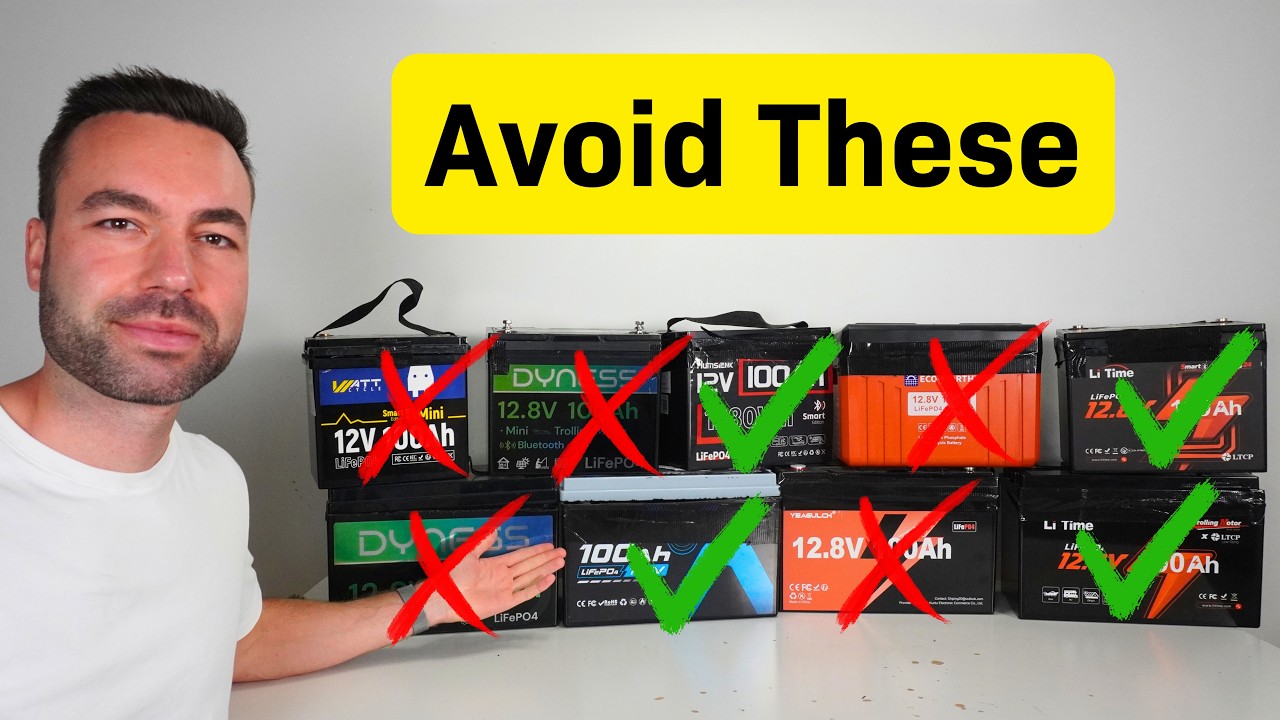
Cleversolarpower ranks nine 12V 100Ah batteries on balancer current; four pass

Nick's cut-off is 50mA of balance current that also works when the battery isn't charging. Most of the nine fell short.

In a summary video on 13 October, Cleversolarpower's Nick ranked nine 12V 100Ah batteries he had opened and tested in separate reviews. His main test is the balancer. He wants at least 50mA of balance current, working whether or not the battery is charging. The discontinued Eco-Worthy V1 had a 35mA balancer that only worked while charging, and a 6.5Ah gap between its highest and lowest cell. The Yeagulch and the Dyness 12V 100Ah share a BMS with a 22mA balancer. The Yeagulch's 100A BMS allowed 200A for seven minutes before a 100°C shutdown. The four that passed were the Vatrer 12V 100Ah with heating (200mA, matched cells; $330), the LiTime Trolling Motor (88mA; $336), the LiTime Group 24 Smart ($311; its app doesn't show cell voltages) and, as a budget pick, the Humsienk (46mA but always on, 108Ah measured; $192). Makers supplied the units; the video has affiliate links.

Off-Grid Garage adds a 100Ah pack to a 530Ah one: brief 50–60A inrush, then a small share of the work

A follow-up to last week's Lead, with a much bigger capacity mismatch. The small pack delivered 4.8A while the 628Ah pack delivered 13.3A.

On 14 October, Off-Grid Garage's Andy connected a Gobel Power Thor 5000 (51.2V, 100Ah, reading 88% and 53.3V) directly to a CATL-cell 530Ah pack in his 48V bank, which was sitting at about 54.9V. The inrush was 50–60A for a few seconds, then it fell quickly. His JK PB BMSes limit current to 10A if it stays over 100A for three seconds. Under a 21A load, the 628Ah MB56 pack supplied 10–11A, the CATL 8.7A and the Thor 1.7A. At about 5.9kW, they supplied 13.3A, 16.8A and 4.8A. Some 280Ah packs nearer the busbar supplied more than larger ones; Andy blames cable length, the path-resistance effect from last week. His own rules of thumb: keep the voltage difference under 1–2V before connecting, and give every pack its own BMS, breaker and fuse.

Digital Yacht previews SafeLi, a hydrogen and temperature sensor for lithium battery compartments

It alarms over NMEA 2000, Wi-Fi and a built-in sounder. Formal launch is at METS in November; detection thresholds and price aren't published.

Digital Yacht showed SafeLi at the Annapolis Sailboat Show (15–18 October) and announced it on 15 October. The unit mounts in the battery compartment. It has a gas sensor "calibrated to detect hydrogen and other VOCs" and a temperature sensor. Alarms go to helm displays over NMEA 2000, to a phone over its own wireless link, to a built-in sounder, and optionally to Digital Yacht's NMEA 2000 klaxon and its Njord cloud service for remote push alerts. Digital Yacht describes it as an "early warning of potential battery distress". It has not published detection thresholds, response time, supply current or price, and those figures will decide how useful it is. A gas sensor reacts to off-gassing from a cell that is already in distress. How early that warning comes depends on the thresholds Digital Yacht hasn't published yet. Formal launch is at METS 2026 (17–19 November).

TEMO brings its 48V OUTPOD sailboat drive to North America: 1,300W or 3,100W, $2,600–$5,400

A pod drive on a bolt-on transom mount, powered by removable 2.3kWh battery cassettes or an existing 48V lithium bank.

French maker TEMO launched its OUTPOD system in North America at the Annapolis Sailboat Show. Panbo ran TEMO's press release on 15 October. OUTPOD puts an underwater pod drive on a bolt-on transom mount, so no hull penetration is needed. There are two versions. The OUTPOD·1000 is 1,300W with 66lb static thrust, rated IP67, at $2,600. The OUTPOD·3000 is 3,100W with 148lb, rated IP68, at $5,400. Both motors weigh 26lb. The DC side is the interesting part. It runs at 48V, from 2.3kWh lithium cassettes that slot into an auto-connecting rack and charge from shore power or at home. TEMO says it also works with an existing 48V lithium bank, solar and hydrogeneration. By our arithmetic, one cassette runs the 3,100W version at full power for about 45 minutes. TEMO hasn't published runtimes. Warranty is three years, with service from Portland, Maine.

The Background · Standards Explainer

A balancer's current rating tells you how many hours it needs

Nick's ranking in News 2 uses one criterion that most battery reviews skip: how much current the balancer moves, and when it is allowed to work. The reason it matters is simple arithmetic.

Drift is in amp-hours, balancing is in milliamps

The four cells in a 12V pack never stay exactly matched. Small differences in self-discharge, and in how much the BMS draws from each cell, push them apart over time. The pack stops charging when the first cell reaches full and stops discharging when the first cell reaches empty. So any gap between cells is capacity you can't use. Nick measured a 6.5Ah gap on the Eco-Worthy V1.

A balancer removes a gap at its rated current, so the time it needs is the gap divided by that current. As an illustration (our arithmetic, not a measurement), a 6.5Ah gap takes:

  • at 22mA: about 295 hours of balancing
  • at 35mA: about 186 hours
  • at 200mA: about 33 hours
  • at JK V22's 0.6A: about 11 hours

The hours you actually get

Those are hours of balancing, not hours of use. Most passive balancers in drop-in packs only switch on near the top of charge. Marine How To puts it at around 3.40V per cell with a 15mV spread, bleeding 30–100mA. A van that reaches full charge for one hour a day gives a charge-only 35mA balancer about one hour a day. At that rate, closing a 6.5Ah gap takes around half a year, if the cells don't drift further in the meantime. A balancer that keeps working at rest, as Nick requires, gets many more hours out of the same current. That is why he passes the 46mA Humsienk and fails the Dyness Trolling Motor.

What the spec sheet won't tell you

Almost no drop-in datasheet states balance current, when the balancer starts, or whether it works at rest. Nick had to open the packs to find out. On the LiTime trolling battery he read it from the balance resistors: 39Ω, about 88mA. Nor do makers publish how fast their cells drift, which is the other half of the calculation. A small balancer on well-matched cells may never fall behind. On cells that drift quickly, it may never catch up. The balancer current alone tells you how fast a pack can recover from drift. It doesn't tell you whether recovery will ever be needed.

The same arithmetic was behind Off-Grid Garage's questions about JK's move from a 2A to a 0.6A balancer in the V22.

Community Pulse

What the forums are talking about this week

Heater season has started on r/vandwellers, and the posts are about keeping heaters running, not choosing one.

On 14 October, an owner's Vevor diesel heater failed to ignite after 1.2 years. They opened it and cleaned it with oven cleaner, without spare parts, following a YouTube guide. Two replacements at $74 each were already on order. A follow-up on 17 October fitted a $17 Amazon parts kit: a paper gasket, a bent atomizer screen, and carbon build-up on the old screen. On 13 October, an owner of a 2.5-year-old van with a Webasto Evo 40 was quoted $1,600 ($600 parts, $1,000 labour) after the builder said a failure at about 600 run-hours isn't covered by the warranty. The same day, an LF-Bros 5kW owner couldn't find how to prime the fuel pump to clear an air bubble because the heater came without a manual.

On the electrical side, an SUV dweller in Portland with an EcoFlow Delta 3 Plus and an alternator charger says they aren't driving enough to keep up, with cloudy winter ahead.

We can read the opening posts but not the replies, so treat these as questions, not settled answers.

On the Bench

YouTube picks: builds, teardowns, firmware walkthroughs, and reviews

100Ah Battery in parallel with 530Ah battery through Bulk, Absorption and Float. Should you?
Build Walk-through
Off-Grid Garage · 14 October 2026
Source for News 3. The inrush is in the first four minutes. The per-pack discharge currents under a 5.9kW load start at about 12:30. The captions render 'Gobel' as 'Google'.
I Built a Website to Expose Solar and Battery Scams
Tutorial
DIY Solar Power with Will Prowse · 13 October 2026
Prowse's six-minute launch walkthrough of Charged Reviews (the Lead): review verification, certificate tracking, the Evidence Score, and how the site makes money.
Cheap Breaker or PV Disconnect: Don't Buy the Wrong One
Teardown
Cleversolarpower by Nick · 16 October 2026
A $27 DC breaker against a $38 PV disconnect switch: voltage ratings, parallel-string overcurrent protection, what's inside each, a water test, UV and certification. Affiliate links in the description.

Product Radar

New and notable components announced or launched this week

12.8V 450Ah / 5,760Wh Group 8D pack; 300A continuous, 600A for 10s; heating below 32°F; Bluetooth, NMEA 2000 and Victron communication; field-replaceable BMS; up to 16 in parallel and 4 in series; 94.8lb. Lists IEC 62619, UL 1973, UL 9540A and UN 38.3.

$2,189 In US stock; shown at the Annapolis Sailboat Show, 15–18 October 2026
The show listing and the product URL say 'Solid State'; the product page itself says 'Semi-Solid State'. Electrolyte content, cell maker, cycle life and warranty aren't published. See our August Background on semi-solid marketing.
Marine

48V pod drive on a bolt-on transom mount. 1,300W / 66lb thrust (IP67) or 3,100W / 148lb (IP68), 26lb motor, powered by 2.3kWh removable cassettes or an existing 48V lithium bank.

$2,600 / $5,400 MSRP Orders open in North America from October 2026
No published runtime figures; one cassette is about 45 minutes at full power on the 3000 by our arithmetic (News 5).
SafeLi — Digital Yacht
Safety

Battery-compartment monitor with a hydrogen/VOC gas sensor and a temperature sensor; alarms over NMEA 2000, Wi-Fi to a phone, built-in sounder, optional klaxon and Njord cloud alerts.

Not published Previewed at Annapolis; formal launch at METS, 17–19 November 2026
Thresholds and supply current not yet published (News 4).
MiniSwitch — Blue Sea Systems
Safety

Battery disconnect that mounts directly on the battery terminal, in a fully enclosed housing; 150A continuous, 450A cranking; UV-stabilised, corrosion-resistant, serrated flange nut.

Not published Announced 13 October 2026
Pitched at storage isolation. 150A continuous is below typical inverter-bank currents. The announcement gives no voltage rating or part number.

Recalls & Safety

Official notices, firmware safety fixes, and reported failures

Safety

Lippert recalls 4,435 power seating assemblies: power cord fuse may not protect against a short

Lippert, the RV component supplier, filed equipment recall 26E070000 with NHTSA on 9 October. It covers 4,435 power seating assemblies. According to the filing, "the power cord fuse may not provide adequate circuit protection", and in a short circuit "inadequate protection increases the risk of a fire". Dealers will replace the power cord free of charge. The owner notification schedule has not yet been provided, and Lippert customer service is on 1-574-538-4514. The summary doesn't name the seat models or RV brands affected, or say whether the cord is on the 12V or the 120V side. NHTSA's recall page will carry the owner letters once they are filed.