· Edition #20

The Busbar

JK ships a cheaper BMS that balances at 0.6A instead of 2A, Panbo puts a semi-solid marine pack on the bench and finds it losing 7% a day sitting still, and Goal Zero fixes a fire risk with an app update.

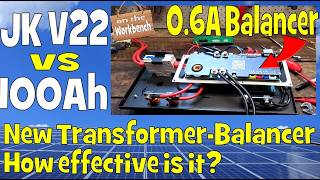
JK's V22 BMS drops the 2A active balancer for 0.6A — a 100Ah pack still sat 42mV apart after two hours

The V22 replaces JK's supercapacitor active balancer with a transformer design rated at 0.6A on every current variant. Off-Grid Garage charged a 16S 100Ah pack through it: cell 1 ran to 3.602V, the spread peaked near 170mV, and after one hour fifty-five minutes of balancing it was still 42mV. The V19 does a three-times-larger pack in half an hour.

JiKong's V22 Inverter-BMS is 20–40% cheaper than the V19, noticeably smaller, and has a Wi-Fi module. It also balances at 0.6A instead of 2A, and that one number is the whole story. On 11 September Andy at Off-Grid Garage published the first real-world charge through one, and the result is not close.

The test pack is a 16S 100Ah battery — small, by the standards of anyone building a shelf. He reset the BMS to LFP defaults, set a 5mV balance trigger and a 3.45V balance start voltage, and charged at roughly 21A from an adjustable supply set to 55.6V. The balancer engaged on schedule at 3.447V on cell 1. Then cell 1 kept climbing: 3.5V, 3.58V, and on to 3.602V, with the pack-wide spread growing to about 170mV while total charge current had already tapered to 2.3A. After one hour forty minutes the spread was 50mV. At one hour fifty-five it was 42mV and, in his words, "the needle is not moving much anymore."

The comparison that matters is against JK's own previous generation. Andy's own shelf runs V19 BMSes with the 2A supercapacitor balancer on packs of roughly 300Ah — three times the capacity of the test battery — and he sets a half-hour absorption window, which is enough. The V22 could not finish a pack a third of that size in nearly four times the window.

The balance method is not simply a smaller version of the old one. The V19 shuttles charge cell-to-cell through a supercapacitor. The V22 discharges the high cell into a transformer and returns the energy to the whole pack — Andy measured the return at around 39mA back into the pack. JK markets this as "active pack balancing." As an architecture it is defensible; at 0.6A it does not have the authority to correct a runner while the pack is still absorbing.

JK's explanation, relayed by Andy, is straightforward and worth repeating without editorialising: the Chinese domestic BMS market is fiercely price-competitive, JK needed a cheaper part, and the supercapacitor bank was expensive. The balance current is identical — 0.6A — whether you buy the 100A, 150A or 200A version, because it is a property of the balancer, not the pack.

Two things this is not. It is not a replacement: JK is keeping the V19 in production, and the V22 is an additional, cheaper line. And it is not a firmware regression that can be patched — this is hardware. His verdict is unusually blunt for him: "this is certainly not a BMS I would recommend."

There is also an integration cost that falls on pack builders rather than buyers. The V22's comms board carries five DIP switches instead of four, and the smaller footprint does not land on the V19's mounting points. Andy had to 3D-print an adapter plate and file the front-panel cutout wider to fit one into an existing battery. Anyone assembling packs around this BMS is re-tooling a front panel, and the part that reaches the end buyer will still say "JK BMS" on it. That is this week's Background.
Panbo bench-tests a semi-solid 48V pack: 150A for 20 minutes, and 7% of the pack gone per day sitting still

Ben Stein put Safiery's 48V 53.1Ah semi-solid LiFePO4 through discharge, cycling and abuse testing. It delivers 150A without complaint. It also draws 157mA doing nothing, and a 55°C cell ceiling holds sustained cycling to 0.42C charge and 0.64C discharge.

Ben Stein published the first independent bench test we have seen of a semi-solid-state marine pack on 8 September, using Safiery's 48V 53.1Ah units — the pack we listed in August when its pricing could not be confirmed. Now it can: $1,642 for the 2C model (5,000W discharge) and $1,711 for the 3C (7,500W, 10,000-cycle claim), both 2,712Wh.

The power delivery is real. Stein ran it from 100% to 0% at 150A and it took 20 minutes, with cell temperature rising from 30°C to 62°C. He reads that as a racing-sailboat or hydraulics use case rather than a house bank, and the sustained figures support him: held under a 55°C ceiling, continuous cycling settled at 22A charging and 34A discharging0.42C and 0.64C. A pack that does 3C in bursts does not do 3C all afternoon.

The number that should give a boat owner pause is the idle one. Stein measured 157mA of self-discharge, which he puts at roughly 7% per day, attributing it to the BMS and its connectivity staying awake. On a boat left on a mooring for a fortnight that is not a rounding error. He also objects to the DVCC float behaviour — 13.8V, or 3.45V per cell, which he considers too high for a float, worked around by dropping the charge current limit to zero and producing micro-cycling instead.

On safety he overcharged a cell deliberately: it vented without fire on the first attempt, and only ignited after more than four and a half hours at around 40V, roughly four times nominal. That is abuse well past anything a charging fault would produce. His conclusion is conditional, not a recommendation: if the use case genuinely needs the throughput and density, the premium is probably worth it.

LiTime puts RV-C, NMEA 2000 and Victron comms on a $929.99 12V 320Ah pack

The ComFlex carries CAN and RS485 and speaks RV-C, NMEA 2000 and Victron — 25-plus parameters — on a 4,096Wh 12V battery at budget-tier money. 200A BMS, 4,000 cycles, five-year warranty.

LiTime announced the LiHeat 12V 320Ah ComFlex on 8 September. The specification that makes it interesting is the connector panel: CAN and RS485 ports carrying RV-C, NMEA 2000 and Victron communication, the last exposing what LiTime states as 25-plus battery parameters. On a 48V rack pack that is unremarkable. On a 12V house battery at this price it is not — bus comms on 12V have generally meant Epoch, Discover or a Victron Lithium NG.

The rest: 4,096Wh, a 200A continuous BMS with a claimed 1,000A one-second peak, 59.97lb, 14.49 × 7.44 × 10.04in, dual-mode self-heating, discharge to -20°C, charge cut-off at 0°C with recovery at 5°C. The app keeps 30 days of history and up to 300 event records, and firmware updates over the air. Up to 16 units parallel with communication, or 4P4S without. LiTime's own page lists 4,000 cycles at 100% depth of discharge and a five-year warranty, read on 13 September at $929.99 against a $1,299.99 list. Europe is given as mid-September.

One caution carried forward. In July we covered Will Prowse challenging LiTime over a UL 1973 claim that disappeared from a 320Ah listing after his review. The company's materials for the ComFlex cite "380+ certifications" in aggregate and itemise none of them, which is not an answer to that question.

Goal Zero recalls 46,200 YETI 3000X power stations for fire risk — the remedy is an app update

Four fires, no injuries, a circuit board that can overheat, and a fix that consumers install themselves through the Goal Zero app. CPSC recall 26-712, announced 20 August; we are late to it.

Goal Zero recalled approximately 46,200 YETI 3000X portable power stations under CPSC recall number 26-712. The defect is stated plainly: "the recalled power station's circuit board can overheat, posing a risk of serious injury from fire and burn hazards." Four reports of units catching fire, overheating or smoking; no injuries reported. The units are the 92lb, roughly 24.4 × 18.5 × 22.3in silver-and-black models.

The remedy is the part worth reading twice. Owners are told to stop using the unit and install a free firmware update through the Goal Zero application, or contact the company for help doing it. No dealer, no return, no hardware. That makes this the second firmware-remedy safety campaign in our coverage after Winnebago's over-the-air fix for the Ekko phantom-generator-start recall in August, and the first we have seen where a consumer product with a fire risk is closed out by an app.

It is a genuinely efficient outcome and also a structural one: a firmware remedy only reaches the units whose owners open the app. A dealer campaign has a VIN list; this has an install base. In fairness to Goal Zero, the alternative for 46,200 92lb boxes is not obviously better.

Dating, honestly: this was announced on 20 August, outside our normal window. It did not appear in our sources at the time and we are running it now rather than not at all.

JK's new Wi-Fi module is a $26 part that also works on V14, V15 and V19 BMSes

It reads whatever is already on the RS485 port, so it retrofits to the older BMSes rather than requiring a V22. It is also a standalone box with no status reporting into the app or the portal.

The Wi-Fi module launched alongside the V22 is sold separately at about $26, and Off-Grid Garage's bench work establishes the useful fact that it is not V22-specific: it reads data already present on the RS485 port, so it will work on a free port of a V14, V15 or V19 BMS as well. If Wi-Fi is the reason you were considering a V22, it is not a reason.

It runs in two modes. In LAN mode it joins your network and serves a local web page with full settings and live data; in WAN mode it connects to JK's own IoT portal for access from anywhere. Setup is the familiar hotspot-then-credentials routine.

Two caveats from the bench, both practical. The module is a genuinely standalone device — its status appears nowhere in the JK mobile app or the online portal, only on the module's own indicator lights, which is an argument for mounting it outside the battery box where you can see it and reach its reset button. And the WAN-mode portal is a website rather than an app: Andy describes it as awkward on a phone, with constant zooming and scrolling. Compare Gobel Power's dongle-plus-cloud arrangement, which we covered in August and which integrates monitoring rather than bolting it on.

The Background · Market Analysis

The BMS is the one component in a bought pack you don't choose, can't see, and can't easily check

The V22 is not replacing the V19. That is the sentence that turns a product story into a market story.

If JK had superseded its old BMS with a cheaper one, the outcome would be unpleasant but legible: everyone's next BMS balances at 0.6A, everyone finds out, the forums adjust. Instead there are now two current JK Inverter-BMS lines, sold concurrently, physically similar, sharing a brand that has spent four years being shorthand for "the one with the strong active balancer." One of them has a balancer that can hold a 300Ah pack together in a half-hour absorption window. The other could not close a 100Ah pack in two hours.

Who actually picks the BMS

Almost nobody reading this chooses a BMS twice. You choose one if you are assembling cells yourself. Everybody else buys a finished pack — a Gobel, a Jakiper, a Ruixu, any of the server-rack boxes that have taken over the 48V market — and the BMS inside it was selected by the pack builder, on the pack builder's margin, months before the box reached a warehouse.

That selection is now a live cost decision with a 20–40% spread on a part that is already one of the cheaper items in the bill of materials. It is also a decision the buyer has almost no visibility into. Listings say "with JK BMS." Some say "JK Inverter-BMS." Very few state a version, and we have not seen one state a balance current.

The re-tooling tax cuts the other way

There is a countervailing force, and it is the reason to be less alarmed than the headline suggests. The V22 does not drop into a V19 footprint. Different mounting points, a comms board with five DIP switches where there were four, a different front-panel cutout. A pack builder switching to the V22 is not swapping a part; they are revising an enclosure. That is real capital and real lead time against a saving of perhaps twenty dollars a pack.

So the near-term risk is not that established 280Ah and 314Ah rack packs quietly get worse. It is narrower and more specific: new product lines, entry-price SKUs, and the smallest builders — the ones who tool a front panel per batch anyway — are where a 0.6A balancer will show up first, and they are the least likely to publish the detail.

Why balance current is not a spec-sheet nicety

A balancer's job is not to keep cells at identical voltage. It is to bleed off the cell that reaches the knee first, fast enough that the pack can finish absorption before that cell hits the BMS's overvoltage cut. Everything below about 3.4V per cell in LFP is flat, the cells look identical, and the balancer has nothing to do. The work all happens in the last few percent, in a window of maybe thirty to ninety minutes, against a charge current that is itself tapering.

Which is why the arithmetic is not linear in capacity. A 0.6A balancer on a 100Ah cell is moving 0.6% of capacity per hour. On a 314Ah cell it is 0.19%. The same part gets weaker as packs get bigger, and packs have been getting bigger every year we have been publishing. JK's 2A balancer was the thing that made a single BMS sufficient on a 628Ah bank without a separate balancer board bolted alongside. Removing it does not break anything immediately; it re-opens a market for the add-on balancers that JK had spent years making redundant.

What a buyer can actually do

Not much, and it is worth being honest about that. Ask the seller which version and what balance current before ordering — a builder who cannot answer has told you something. After delivery the JK app shows the firmware version, and the V22 reports in the 22.x series. And the behaviour is visible without any of that: charge the pack to full, watch the spread at the top, and time how long it takes to close. A pack that is still 40mV apart an hour into absorption is telling you what is inside it.

Community Pulse

What the forums are talking about this week

A useful accident of timing on r/vandwellers this week. While the DIY world argued about balance currents, a first-time builder posted that their new LiFePO4 battery will not charge, that they have paired the app over Bluetooth, and that they cannot find a button in it to turn the battery on. That is the actual entry point to battery management for most people: not a balancer spec, a screen with no obvious switch on it. Nobody who buys a pack with a good BMS and a bad app is better off than the reverse.

A second thread is the perennial one, asked well. A builder with a 1kW inverter and a Safety Hub 150 has been told by one person to bond the inverter to the van chassis and by another not to bond the negative busbar, and cannot reconcile the two — which is reasonable, because the answer depends on whether the inverter's AC output neutral is bonded and on what the DC negative is doing, and the two questions get answered as if they were one. And a third, from day three of self-education, simply asks which resources are worth trusting.

We can read only the opening posts — the forum bodies are not reachable from this environment — so treat these as questions asked, not answers reached.

On the Bench

YouTube picks: builds, teardowns, firmware walkthroughs, and reviews

They removed THE unique selling point of the JK-BMS. How effective is the new transformer Balancer?
Teardown
Off-Grid Garage · 11 September 2026
The source for this week's Lead, and worth watching in full for the install as much as the result — a 3D-printed adapter plate, a filed front-panel cutout for the fifth DIP switch, then a charge held on camera long enough to show a balancer failing to converge in real time. One video, one channel this week; nothing else eligible published in the window.

Product Radar

New and notable components announced or launched this week

Battery

Smaller, cheaper generation of the JK Inverter-BMS. Transformer-based 'active pack balancing' rated 0.6A on every current variant, replacing the V19's 2A supercapacitor balancer. Comms board carries five DIP switches; an optional Wi-Fi module (about $26, LAN or WAN mode) connects to a new UART port.

Under €100 for the 200A version including the Wi-Fi module at AliExpress retail; stated as 20–40% cheaper than the V19 Shipping via AliExpress sellers; sold alongside the V19, which remains in production
Cheaper, smaller and Wi-Fi-capable. Also the first JK BMS in years that we would not put on a large pack without an external balancer next to it.
Battery

12.8V 320Ah / 4,096Wh LiFePO4 with CAN and RS485 carrying RV-C, NMEA 2000 and Victron communication (25+ parameters). 200A continuous BMS with claimed 1,000A one-second peak, dual-mode self-heating, 59.97lb, 14.49 × 7.44 × 10.04in, 30-day history and 300 event records in-app, OTA firmware. 4,000 cycles at 100% DoD, five-year warranty.

$929.99 (list $1,299.99), read from LiTime's own product page on 13 September 2026 US now; Europe given as mid-September 2026
Real bus comms on a 12V pack at this money is the news. The blanket '380+ certifications' claim, with none itemised, is not.
GMI 40 — Garmin
Monitoring

4.3in colour marine instrument display with edge-to-edge glass, NMEA 2000, Garmin BlueNet and wireless sensor support. Shows wind, depth, speed, temperature and engine data. An adapter plate is offered for GMI 20 retrofits.

$599.99; sensor bundles $1,099.99–$1,899.99 Available now
Not a DC-system product, and listed here for the contrast rather than on its own merits. Three weeks ago Panbo's own editor built a 4.3in colour NMEA 2000 display on a $50 dev board in an afternoon, which we made that week's Lead. This is what the certified, waterproof, daylight-readable, properly-addressed version of the same screen costs — and nearly all of that gap is the work the homebrew build skipped.

Recalls & Safety

Official notices, firmware safety fixes, and reported failures

Safety

Kibbi files the largest MaxxAir Maxxfan PCB campaign yet — 505 Renegade RVs

Kibbi, LLC — NHTSA #26V574000, report received 5 September, 505 units. The defect is the one we have tracked since July: certain 2026–2027 Renegade RVs are fitted with MaxxAir N-Series Maxxfan rooftop ventilation fans whose printed circuit board "may fail during certain operations and overheat," with an increased risk of fire.

The affected models are the Renegade Valencia, Verona, Vera Cruz, Vienna, Villagio, Verona LE, XL, Garage, Totter, Explorer TS, Explorer and Classic. Dealers will inspect and replace the board free of charge; owner notification letters are expected 19 October 2026. Notably, the contact NHTSA lists first is Airxcel — the fan's own manufacturer — on 574-247-9235, rather than Kibbi.

At 505 units this is the largest single campaign in the group, and it is the seventh builder to file on this defect, after Tiffin #26V412, Grand Design #26V446, Winnebago #26V450, Forest River #26V477, Airstream #26V401 and Rossmonster #26V538.

Safety

Storyteller Overland becomes the eighth builder on the same fan — run now stands near 2,138 units

Storyteller Overland, LLC — NHTSA #26V566000, report received 1 September, 169 units: certain 2026–2027 MODE and 2026 GXV HILTS vehicles, same MaxxAir N-Series Maxxfan PCB defect, same fire risk. Storyteller will inspect and replace the board free of charge; owner letters are expected 30 October 2026.

With Kibbi above, that is the eighth builder. Our running total across all eight campaigns is now approximately 2,138 units — 425 + 448 + 134 + 69 + 303 + 85 + 505 + 169 — which is our own arithmetic and has not been published by NHTSA or MaxxAir.

The point we have made at every stage still stands and gets sharper with each filing. There is still no component-level recall on the fan itself. Every one of these eight campaigns reaches owners through the vehicle builder, which means anyone who fitted a MaxxAir N-Series to their own van or boat as an aftermarket part is covered by none of them and has no notification route at all.