· Edition #27

The Busbar

Panbo's year-long cycle test puts a $170 WattCycle 12V battery near 2,000 cycles and under $0.10 per delivered kWh, while WattCycle and Will Prowse publish competing data on its 48V rack battery.

Panbo's cycle test: $170 WattCycle 100Ah nears 2,000 cycles, projected at about half its rating

Ben Stein projects 2,592 cycles for the WattCycle and 3,607 for a Blue Heron Extreme, 52% and 60% of their ratings. He doubts cycle count will be what ends either battery's life.

Panbo editor Ben Stein posted the third update on his continuous LiFePO4 cycle test on 26 October. A WattCycle 100Ah is approaching 2,000 cycles, and a Blue Heron Extreme 100Ah has passed 1,100. Both batteries run from 100% to 10% state of charge and back again, non-stop, at about 0.5C (50A) each way. Stein treats 80% of original capacity as end of life and projects each battery's lifespan by drawing a straight line through its fade so far. We last reported on the test in May, when the WattCycle had passed 1,100 cycles.

On that basis the WattCycle is projected at 2,592 cycles and the Blue Heron at 3,607. That is 51.8% and 60.1% of their 5,000- and 6,000-cycle ratings. Stein thinks both ratings come straight from the cell maker's datasheet: "I don't believe any LiFePO4 battery manufacturer is doing any sort of testing on their finished batteries to determine a real world number."

The projections have moved around a lot. At 200 cycles the Blue Heron had lost 3.48%, which projected to just 1,149 cycles. By 1,000 cycles the projection had risen to 3,378, and it is still going up. The Blue Heron reports 40–45°C internally while cycling. The WattCycle has no Bluetooth or CAN, so its temperature is unknown. Its projection dipped around 700 cycles and then recovered.

The WattCycle has now delivered 143,149Ah, or 1,823kWh. On a $170 purchase price, that is under $0.10 per kWh so far. Stein's conclusion is that over ten years the projections allow one full cycle every 1.4 days (WattCycle) or every day (Blue Heron), and that few boats cycle that hard. In his view, "storage temperature may have the biggest impact on battery life." He has increased full capacity tests from every 100 cycles to every 20. A flooded lead-acid comparison failed: the battery boiled over. He will try AGM next.

The sample is two batteries, which Stein acknowledges. Also note that this WattCycle is a 12V 100Ah, not the 48V rack battery in this week's News 1.
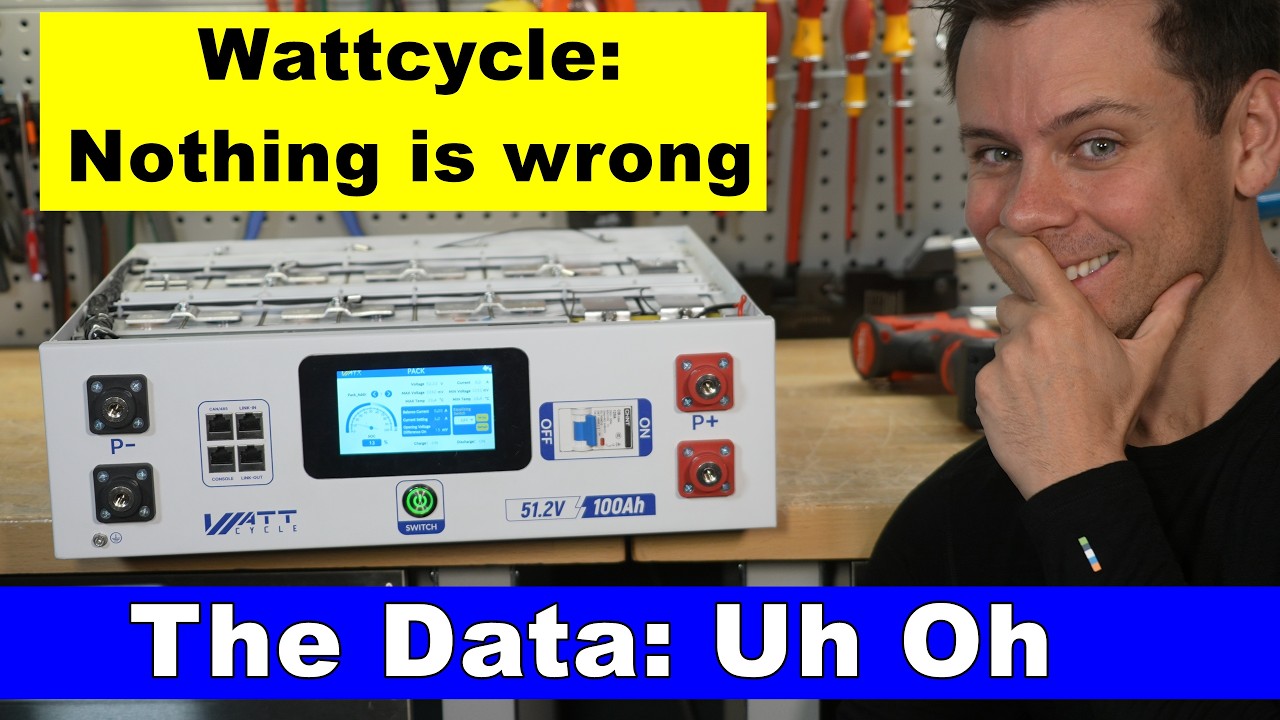

WattCycle publishes 10-cycle data on its 48V rack battery: under 1% loss at 50A

Will Prowse says an earlier WattCycle data file, since removed, showed the same fade he measured. He blames a balancer that runs at every state of charge.

On 30 October, WattCycle posted cycle data for two 48V 100Ah rack batteries, cycled at 50A between 58.4V and 38.4V with active balancing on its default settings. Over ten cycles, capacity fell from 106.034Ah to 105.508Ah (−0.496%) on one and from 105.986Ah to 105.224Ah (−0.719%) on the other. WattCycle says it is running 200 cycles on each of ten batteries and is "preparing to open access to supported BMS configuration settings".

On 29 October, Prowse said an earlier WattCycle statement described a 100A test, but its data file was labelled 50A, had no cycling profile, and was later removed. He says that data matched his. He blames the active balancer, which runs "at all states of charge" (see last week's Lead). On a battery with a similar BMS, switching off only the active balancer reversed the loss over several 80A cycles. Neither side's claims have been independently checked.

Off-Grid Garage: the TDT 1001 BMS is a drop-in physical match for the JK Inverter-BMS

Same footprint, mounting holes and connectors. It adds alarm thresholds and efficiency settings, but its Wi-Fi has no local-only mode.

In a 27 October first look, Off-Grid Garage's Andy showed that the TDT 1001 is a 16S, 200A BMS with a 2A capacitive active balancer. It measures 300 × 100 × 18mm, and its mounting holes, balance connectors and communication board match the JK Inverter-BMS, making a swap "very easy". He priced it at AU$225, or AU$245 with Wi-Fi, against AU$203 for a JK with the same screen and comms board but no Wi-Fi. The TDT has things the JK lacks: alarm levels set below the protection limits, and adjustable charge and discharge efficiency settings for state-of-charge counting (99% by default). Two problems: unlike the JK's, the TDT's Wi-Fi has no local-only (LAN) mode, so it can't be kept off the vendor's cloud. And on a Victron GX it showed 0Ah available at 100%, a bug that new TDT firmware didn't fix. So far it has only been tested on a 5Ah pack.

Power Queen's Group 24 cranking-and-house battery keeps 15% back for a restart, but doesn't say how

100Ah, 900CCA, self-heating, $369.99. The 'Smart Power Reserve' is the headline feature, and neither the release nor the product page explains how it works.

Power Queen announced the 12V 100Ah Group 24 Dual Purpose LiFePO4 on 27 October. It is rated 900CCA and 1,280Wh, and pitched at outboards "up to 250hp, subject to starting-current and charging-system requirements". It weighs about 22.7lb and is rated IP67. It self-heats (30–60 minutes from −10°C) and stops charging below 0°C. The headline feature is a 15% "smart emergency power reserve" that holds back energy for the next engine start. The release and the product page don't say how the BMS enforces that 15%, whether the boat's house loads are cut off when it is reached, or how the reserve is released. That matters if your bilge pump runs off the same battery. The product page says the battery "complies with ABYC E-13 installation standards" but names no test lab or certificate. The page went up in September; the price is $369.99 (listed down from $499.99), with a five-year warranty.

Signal K Server 2.34 and 2.35: Bluetooth connection fixes and another security fix

A month after the September authentication-bypass advisory, two releases tighten security and fix how Bluetooth GATT connections are claimed and released.

Signal K Server v2.34.0 shipped on 18 October and v2.35.0 on 24 October, with v2.35.1, a no-change re-release, the same day. For boats that read battery monitors and chargers over Bluetooth, the relevant changes are in 2.34. A hung GATT connection can no longer tie up a device. Plugins now release their Bluetooth claims when they stop. And discovery pauses while a connection is being set up. 2.35 releases devices that BlueZ, the Linux Bluetooth stack, no longer lists. On security, 2.34 moves the JWT secret out of security.json, and 2.35 adds "reject path characters in identifiers". These follow v2.33.0, which fixed the authentication bypass we covered in September. One build note: 2.34 removes the "armv7 (Cerbo GX) / Node 20" job from Signal K's plugin test pipeline. The release notes don't say what that means for running plugins on a Cerbo.

The Background · Standards Explainer

A cycle rating is a lab result with three conditions attached

Both of this week's battery stories turn on the same question: how many cycles a pack will really do. The number printed on the box rarely answers it, because it was measured somewhere else, under conditions you won't match.

Where the number comes from

Take the EVE MB31, the 314Ah cell behind many of this year's budget packs. Its rating, as a US cell reseller lists it, is "8000 cycles at 25°C to 70% SOH" under a 0.5P (half-rated-power) charge and discharge protocol. That rating depends on three conditions: a fixed temperature of 25°C, a moderate rate, and an end point of 70% of original capacity. Change any one of them and you have a different number. Stein's test, by comparison, ends a battery's life at 80%, so it would stop well before a 70% test does. His Blue Heron also cycles at 40–45°C internally, and LFP ages faster when warm. Stein suspects that pack ratings like WattCycle's 5,000 and Blue Heron's 6,000 come straight from cell datasheets, not from tests of the finished battery.

Nobody runs it to the end

Eight thousand cycles at one a day is about 22 years, so no one tests that far. Cell makers extrapolate, and Stein points out that if fade isn't linear, the projection "could be pretty far off". His own data shows this. After 200 cycles, the Blue Heron's straight-line projection was 1,149 cycles. After 1,000 it was 3,378. Early fade was steeper than later fade, so the early projection was too pessimistic.

Why ten cycles can't settle a dispute

WattCycle's rack battery lost 0.496% and 0.719% over ten cycles. Run those figures through Stein's straight-line method to an 80% end of life (our arithmetic, not WattCycle's), and you get roughly 280 to 400 cycles. Nobody, including WattCycle, is claiming that. It just shows that ten cycles can't be extrapolated in either direction. The first cycles include break-in and, with an active balancer, balancing that hasn't settled yet. Prowse argues that the problem he found builds up over cycles and depends on depth of discharge. Ten cycles can show capacity at delivery and whether something is badly wrong. They can't show what a battery will do over its life.

What would

Months of cycling with regular full capacity tests and a stated temperature, which is what Panbo is doing. Its sample is two batteries, though, and it will be years before either reaches 80%. Until manufacturers publish tests of finished packs, a cycle rating tells you which cell is inside and what that cell did in its maker's lab at 25°C. It doesn't tell you how the pack will do in a warm battery locker.

Community Pulse

What the forums are talking about this week

This week's r/vandwellers electrical questions were mostly about cable and supply sizing.

On 31 October, a builder asked whether a single 70mm² cable is enough between two paralleled 280Ah batteries and a Lynx Distributor feeding a MultiPlus-II 12/3000 through a 400A MEGA fuse. The run is about 1m, and the cable maker rates it at 485A. The poster says they've seen Victron recommend 2 × 50mm² per pole. On 29 October, someone planning to live full-time in an eSprinter, E-Transit or Master E-Tech asked whether the traction battery could run a roof heat pump and every house load, with no separate house bank. On 30 October, a builder with marine-grade stranded 12/3 already in the walls asked whether to splice Romex onto it to connect self-contained-device outlets, and whether WAGO connectors can sit behind the panels.

We can read the opening posts, not the replies.

On the Bench

YouTube picks: builds, teardowns, firmware walkthroughs, and reviews

The TDT-BMS - the Best of JK and PACE in one BMS?
Review
Off-Grid Garage · 27 October 2026
News 2 source. A 43-minute first look comparing the TDT and JK side by side, then the PC software, app and Victron GX integration. Bench-only on a 5Ah test pack; no capacity or SoC-accuracy testing yet.

Product Radar

New and notable components announced or launched this week

Battery

16S LiFePO4 inverter BMS, 200A, 2A capacitive active balancer, 300 × 100 × 18mm with JK-matching mounting and connectors; RS485/CAN protocols include Victron, Growatt, Voltronic, Pace.

AU$225 (AU$245 with Wi-Fi), per Off-Grid Garage Shipping
Its Wi-Fi has no LAN-only mode, and it has a GX available-capacity bug that new firmware didn't fix (News 2).
Marine

LiFePO4 cranking-and-house battery: 900CCA, 1,280Wh, IP67, self-heating, Bluetooth, 15% 'smart emergency power reserve'; about 22.7lb.

$369.99 (listed down from $499.99) Available now
How the 15% reserve is enforced and released isn't documented (News 3).

Mains charger for 12V LiFePO4 using a GaN power stage: 14.6V/10A (146W), 100–240V AC in, IP67, fanless, three-stage charging, 0V wake for BMS-protected batteries; 6.30 × 2.53 × 1.50in.

$99.99 (listed down from $149.99) Pre-order, estimated to ship 11 November 2026
Listed certifications are CE, FCC and RoHS only, with no UL or ETL listing. The fixed 14.6V target can't be adjusted.

Recalls & Safety

Official notices, firmware safety fixes, and reported failures

Safety

Heartland fifth wheels: power-seat cord fuse, the Lippert defect again (518 units)

Heartland filed NHTSA recall 26V710000 (Heartland 990182) on 27 October. It covers 518 2024 Torque, Bighorn and Cyclone and 2022–2023 Gravity and Road Warrior fifth wheels with power seating assemblies. "The power cord fuse may not provide adequate circuit protection", and in a short circuit that increases the risk of fire. Dealers will replace the harness and power cord free of charge. Letters are due 30 November 2026. Heartland: 1-877-262-8032. The wording is identical to Lippert's equipment recall 26E070000 and Alliance's 26V680000. Heartland's summary doesn't name Lippert.

Safety

Ember E-Series travel trailers: same power-seat cord fuse (259 units)

Ember Recreational Vehicles filed recall 26V714000 on 28 October. It covers 259 2024 E-Series travel trailers with power seating assemblies and has the same defect wording. Dealers will replace the power cord free of charge. Letters are due 23 November 2026. Ember: 1-844-732-4204. With Alliance, Heartland and Ember, three RV makers have now filed recalls against the Lippert seat cord. As before, the summaries don't say whether the cord is on the 12V or the 120V side.