· Edition #23

The Busbar

Grand Design recalls 16,128 Reflection fifth wheels because their auto-detect solar controller can choose 24V output on a 12V trailer — three weeks after RVIA began requiring listed solar controllers on new RVs.

Grand Design recalls 16,128 Reflection fifth wheels: the solar controller can pick 24V output on a 12V trailer

On some 2024–2027 Reflections, the 12V/24V auto-detect solar controller can choose the wrong system voltage and damage the 7-way bulkhead power center. Brakes and exterior lights hang off that circuit. The fix is a software update; owner letters go out 16 November.

On 24 September Grand Design RV filed NHTSA recall #26V616000 (Grand Design #910068) covering 16,128 2024–2027 Reflection fifth-wheel trailers. NHTSA's summary: "The auto detect solar controller may select a 24 volt output when the electrical system is designed for 12 volts. The incorrect voltage may damage the 7-way bulkhead power center and other circuits."

There are two consequences. A damaged power center is a fire risk. And because the 7-way bulkhead serves the trailer's running gear, damage there "may cause the trailer brakes or exterior lightings to fail, increasing the risk of a crash." Only trailers built with both a 12V/24V auto-detect controller and the 7-way bulkhead power center are included. Units with a controller that has no 24V output mode are not.

The remedy is "an over-the-air (OTA) software update", plus a free inspection of the lighting and repair where needed. Owner letters are due 16 November 2026. Grand Design customer service is on 1-574-825-9679. The filing does not say how the update reaches a trailer. Nor does it name the controller supplier, and we have not identified it: Grand Design's own solar FAQ says only that it fits controllers "from 25A to 50A".

NHTSA also does not say what makes the controller choose 24V. Controller manuals show why the decision is fragile. A controller that guesses system voltage from what it measures at the battery terminals can guess wrong. We look at how two manufacturers handle it in this week's Background.

This is the third safety campaign in our coverage where software is the fix, after Winnebago's Ekko and Goal Zero's YETI 3000X. The timing is awkward: RVIA began enforcing a requirement for listed solar charge controllers on new RVs on 1 September (News 1). A listing tests the controller. It does not test the voltage the controller decides it is in.

RVIA now enforces listed solar controllers sized to cold-corrected V_OC on factory-solar RVs

Since 1 September, an RV that ships with solar must have an NRTL-listed charge controller rated for the array it feeds. Renogy brought UL 1741 controllers to the Elkhart supplier show to sell into the rule.

Mandatory enforcement of RVIA's adopted standards — the 2026 edition of NFPA 1192 and the 2025 ANSI/RVIA DC Voltage Systems standard — started on 1 September, through inspections at member plants. Under Section 2-7 of the DC standard, an RV that ships with solar must have a charge controller "listed by a nationally recognized testing laboratory and rated for the array it feeds". According to RV PRO's 1 October summary, that rating means input power of at least 125% of the array maximum, and input voltage of at least the array's cold-corrected open-circuit voltage. That is the same calculation behind September's Lead, now written into a standard. Renogy showed its REGO MPPT controllers, certified to UL 1741, CSA C22.2 No. 107.1 and IEC 62109, at the Hall of Fame RV Supplier Show in Elkhart (28–30 September). Aftermarket installs are not inspected by RVIA.

Cerbo GX MK3 moves to a quad-core TI AM625 with the same ports as the MK2

Panbo reports four cores at 1.4GHz, 1GB DDR4 and 25 VE.Direct devices, up from 15. Victron's own product page still shows only the MK2.

Panbo's Ben Stein reported on 2 October that the Cerbo GX MK3 replaces the MK2's dual-core 1.2GHz processor with a TI Sitara AM625: four Cortex-A53 cores at 1.4GHz, built on a 16nm process, with 1GB DDR4. The supported VE.Direct device count rises from 15 to 25, and the ports are unchanged. In Victron's community forum, moderators describe the MK3 as aimed at systems with many components and heavy Node-RED use, with the MK2 still fine for ordinary installs. One user reported list pricing roughly €50–60 above the MK2. US retailers show $393 list; Victron has not published a price. The MK3 was first teased in July. When we checked, Victron's Cerbo product page did not yet mention it.

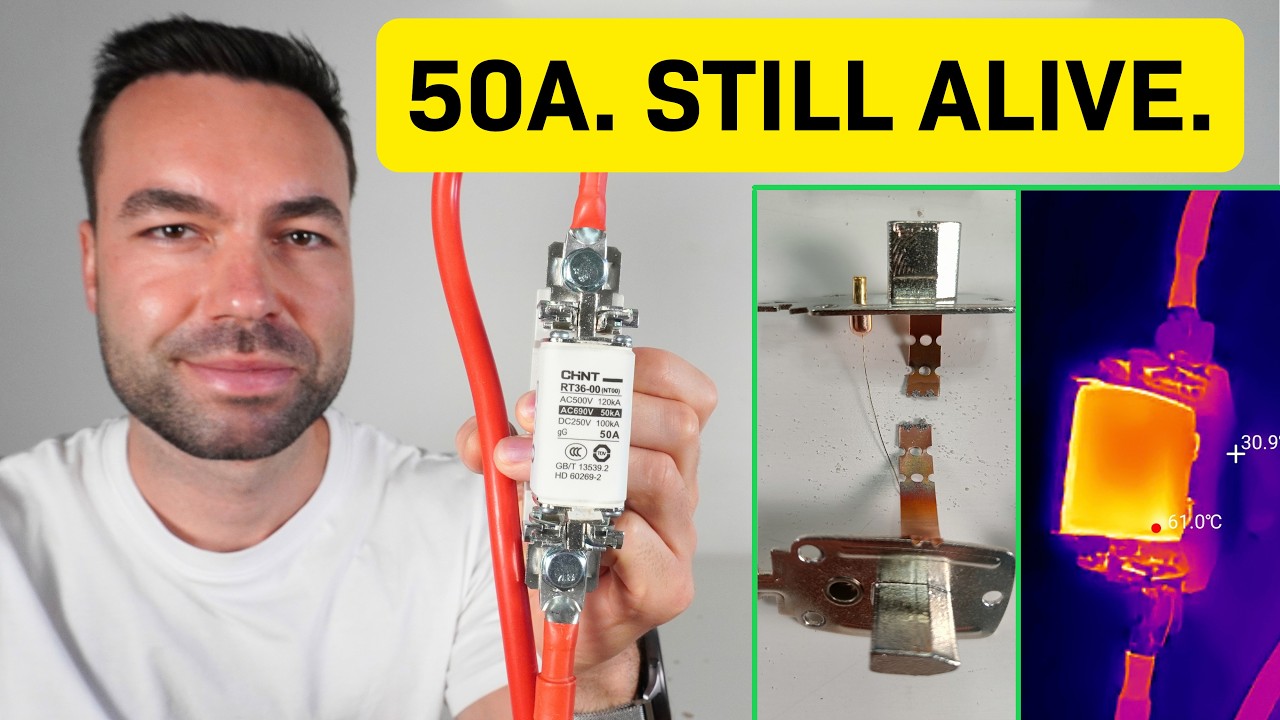
On a 12V bank, a melted NH fuse can stay in circuit with no indicator pop

In Cleversolarpower's overload tests, the inverter's low-voltage cut-out tripped before the fuse finished blowing. The element was ruined, and from outside the fuse looked fine.

Cleversolarpower (Nick) tested 50A NH000 industrial fuses on a battery bench in a 21 September video. At 50A the fuse ran 32 minutes at about 60°C without blowing, as its time-current curve allows. At 100A the element began melting after about three minutes and dropped 2.4V across the fuse. That pulled the 12V inverter below 11V and it shut down. At 200A the same thing happened. Each time, the element had failed but the indicator wire, which needs the full current to burn through, had not. Repeated at 24V and about 93A, the inverter kept running and the striker pin popped. His conclusion: on 12V, a fuse that looks intact may not be. These fuses are rated 250V DC and built to HD 60269-2, but they are not UL-listed. The video description carries his affiliate links.

Battle Born's parent gets a liquidity-covenant waiver and splits a preferred dividend

Dragonfly Energy's lenders waived its September minimum-liquidity test and accepted a staged dividend payment, for a $450,000 fee added to the loan.

An 8-K filed on 2 October shows that Dragonfly Energy (Battle Born, and since July Dakota Lithium) signed a Limited Waiver and Eighth Amendment to its term loan on 30 September. The lenders waived testing of the minimum liquidity covenant for the month ending 30 September. They also waived any default from deferring part of the Series B preferred cash dividend due 1 October: 2% is due by 1 October and the remaining 6% by 30 October. The $450,000 amendment fee is added to principal rather than paid in cash. For context, Dragonfly reported $6.28M cash at 30 June. A covenant waiver is not a default, but a company that can comfortably meet a liquidity test does not ask to have it waived. Q3 results are the next data point.

Victron opens Click & Design to anyone; off-grid design mode still 'under development'

The browser system-design tool no longer needs a Victron Professional account to open. Off-grid systems, with or without a generator, are not supported yet.

Victron's Click & Design ESS design tool, which gained 120V and split-phase support in June, is now "available to everyone", Victron said on 28 September. The goal is to let installers share designs with customers who have no Victron Professional login. Saving a design still needs a Victron account; editing a shared link does not. Also new: French, Ukrainian and Dutch (German and Spanish "coming soon"), installer branding on PDF reports, a simulation that "accounts more precisely for the transfer and conversion losses", and separate monthly figures for priority and non-priority loads. For most of our readers the key line is the last one: "Off-grid systems with and without generators are under development." For now it remains a grid-connected tool.

The Background · Trend Piece

System voltage should be a setting. Some controllers treat it as a guess

A 12V/24V auto-detect controller is designed for the moment of installation. The installer connects a battery, and the controller looks at the terminal voltage and decides what kind of system it is in. In a workshop with a known battery, that works. Grand Design's recall in this week's Lead shows the cost when the guess is wrong in the field: 16,128 trailers whose controller may decide a 12V system is 24V.

Two ways to guess

Published manuals show two different approaches. Victron's SmartSolar MPPT manual says the battery voltage "is automatically detected at the very first power-up of the solar charger" and then stored, and that "further automatic detection is disabled". It waits 10 seconds and averages the reading. If there is no battery and the controller is powered from its PV terminals, it "will default to 12V and store that". The guess happens once, and the fallback is the lower voltage.

Morningstar's ProStar MPPT manual describes the other approach. In auto-detect mode, "battery voltage over 15.5V will be detected as a 24V nominal battery", and "the 12/24V auto selection is only done at start-up". Each start-up is a new decision. On 12V, 15.5V is not an impossible reading at the terminals: an equalisation or float setting gone wrong, an alternator regulator fault, or another charger on the same bus can all produce it. Morningstar's own advice is blunt: "Generally, the specific system voltage is known, and it is best to set DIPs 2,3 accordingly; the auto-detect setting should be used only in rare circumstances."

We don't know which approach the controller in the Reflection uses. NHTSA's summary does not say what triggers the wrong selection, and we are not guessing. The design question applies either way.

Why a factory build is the wrong place for auto-detect

An RV builder knows its system voltage before the first wire is cut. Every Reflection in the recall population was designed for 12V. For a factory, auto-detect saves nothing: it gives a decision the engineer has already made to a measurement taken at power-up. It makes more sense for a distributor stocking one SKU for 12V and 24V customers, and that is probably why such controllers end up on build lines. The cost of that convenience falls on whatever sits downstream. Here, that is a 7-way bulkhead feeding brakes and lights.

What listing doesn't cover

RVIA's new rule (News 1) asks for a listed controller, rated at or above the array's cold-corrected V_OC and 125% of array power. Those are good requirements, and they are about the array side. A UL 1741 listing evaluates the controller as a product. It does not evaluate whether a controller that can output 24V belongs in a 12V trailer, or what it does when it guesses wrong. That is an integration decision, and integration is the builder's job.

Most auto-detect controllers show what they have decided — in an app, on a display, or through DIP switches — and many let you fix the value by hand. That setting is made once, and then the controller no longer guesses.

Community Pulse

What the forums are talking about this week

Two r/vandwellers questions from 3 October are worth noting.

One owner is putting a van into unheated indoor storage for six months with no power, at around 10–15°C. They have a Renogy Core Mini 12V 200Ah and have found conflicting advice online. Their options: leave it in the van disconnected, bring it indoors disconnected, or bring it indoors on some kind of maintenance connection. The relevant background is our June piece on calendar ageing: resting state of charge and temperature matter more over six months than anything done to the battery in that time.

The second is on a fifth build — a 2026 Transit high-roof 148 — and adding a Dometic RTX2000. Older threads sized that unit at about 600Ah and 600W of solar. This builder plans 628Ah from two 314Ah "mini" batteries and asks whether two or three years of cell-density gains change the sizing. The weight and space have changed; the air conditioner's energy demand has not.

We can read the opening posts but not the replies, so treat these as questions, not settled answers.

On the Bench

YouTube picks: builds, teardowns, firmware walkthroughs, and reviews

Huge RS485 Data Bus Installation, so all JKs can talk!
Build Walk-through
Off-Grid Garage · 29 September 2026
Running one RS485 bus from a GX to a shelf of JK BMSes through RJ45 terminal blocks. The useful detail is the pinout: the JK puts RS485 A/B on pins 1 and 2, so T-568A versus T-568B wiring decides whether the bus works at all.

Product Radar

New and notable components announced or launched this week

REGO MPPT 30A / 60A — Renogy
Solar

MPPT charge controllers listed to UL 1741 and CSA C22.2 No. 107.1 and certified to IEC 62109. Per Renogy's listings, the 30A covers 12–48V systems with up to 150V PV input, IP43. The 60A is 12V-only, up to 800W PV, 15–100V MPPT range.

Not stated in the launch coverage Shown at the Hall of Fame RV Supplier Show, Elkhart, 28–30 September 2026
Newly relevant, not new. These are part of Renogy's pitch to RV builders under the RVIA listing rule (News 1). Note that the 60A is a fixed 12V unit, so the Lead's wrong-voltage problem can't occur.
Cerbo GX MK3 — Victron Energy
Monitoring

GX system controller with a TI AM625 quad-core Cortex-A53 at 1.4GHz, 1GB DDR4, up to 25 VE.Direct devices (MK2: 15), and the same ports as the MK2.

Not published by Victron; US retailers list $393 Orderable via distributors; some US retailers show pre-orders shipping from about 9 October
If your Cerbo struggles with Node-RED, Signal K or many devices, this addresses it. If not, Victron's own moderators say the MK2 is still enough.

12.8V 300Ah LiFePO4 (3,840Wh), 300A BMS, 600A peak for 3 seconds, self-heating for cold charging, built-in cooling fan for sustained high current, Bluetooth app, M8 terminals, 71.65lb, 5,000+ cycles at 80% DoD.

$799.99–$839.99 on Vatrer's store (list $1,399.99); promotional Announced 1 October 2026 (RV News); listed on Vatrer's US store
A fan in a 12V pack is unusual. Vatrer doesn't say what temperature switches it on or what IP rating the pack keeps with a fan opening. Both matter for a battery under a bed or in a locker.

Recalls & Safety

Official notices, firmware safety fixes, and reported failures

Safety

Grech Motors becomes the ninth builder to recall MaxxAir N-Series Maxxfan circuit boards

Grech Motors filed NHTSA recall #26V628000 on 30 September: 134 2027 Strada and Terreno and 2026–2027 Turismo motorhomes with MaxxAir N-Series Maxxfan roof fans whose "printed circuit board may fail during certain operations and overheat", which is a fire risk. Dealers will inspect and replace the board free. Owner letters are due 30 October. It is the ninth builder campaign on this supplier defect. By our arithmetic the total is now about 2,272 units (the 2,138 we counted on 14 September plus 134). There is still no recall on the fan itself, so owners who fitted a Maxxfan aftermarket aren't covered by any of the nine.